News
-
The Benefits of Indoor Plants in Classrooms: Celebrating Teachers’ Day with Nature’s Touch Monday, 05 October 2026
-
plants@work congratulates Ian Drummond on another accolade Wednesday, 30 September 2026
-
Celebrating Our Industry, Inspiring Its Future, Leaf Awards Conference, 8 October 2026 Tuesday, 22 September 2026
-
Don’t panic, stay calm – it’s 100 days to Christmas! Wednesday, 16 September 2026
plants@work
From Niche to Necessity: New EU Report Validates the Power of Building-Integrated Nature
For years, the interior landscaping and living wall industry has championed the idea that plants are not just aesthetic additions but essential infrastructure for healthy living. A landmark report,Implementing Green Roofs and Walls: Lessons from European Experience, recently published by the European Union’s Publications Office and highlighted by EurekAlert has finally moved the needle, positioning green roofs and walls as "potent nature-based solutions" critical to the EU’s climate and biodiversity goals.
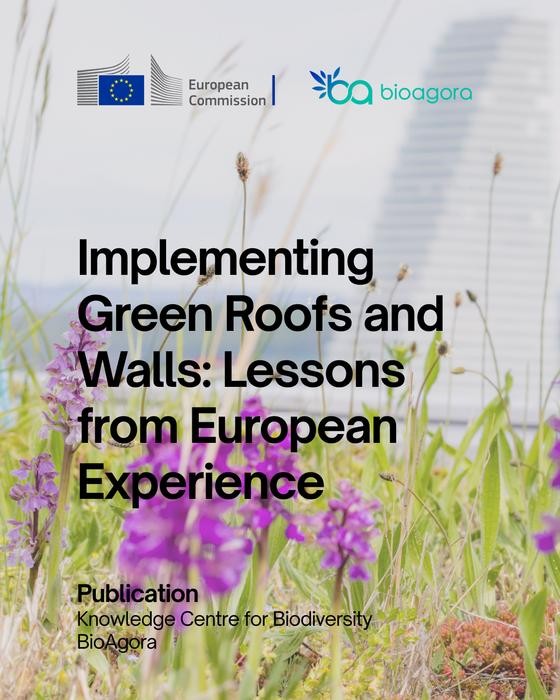
Implementing Green Roofs and Walls: Lessons from European Experience.
© Stephan Brenneisen. Visual design: Pensoft Publishers
For members of plants@work, this report serves as a powerful evidence base to present to clients, architects, and policymakers. It signals a shift from viewing nature as a "luxury" to seeing it as a "scalable, multifunctional urban solution."
The report was commissioned to support the implementation of the EU Nature Restoration Regulation, the EU Biodiversity Strategy for 2030, and the Energy Performance of Buildings Directive. By integrating these green systems into the very fabric of the buildings, the EU aims to restore urban ecosystems and improve climate resilience without competing for scarce land.
The synthesis of 46 case studies across Europe, including the UK, provides measurable evidence of the benefits that professional plant installations bring to the built environment:
- Thermal Regulation & Energy Savings: Green walls and roofs act as natural insulation. The report notes significant "cooling-energy savings," which is vital as urban centres face increasing heat stress.
- Air Quality & Well-being: Beyond carbon sequestration, these systems are proven to improve air quality and provide "social and microclimatic benefits." For the workspace, this translates to healthier, more productive environments.
- Biodiversity "Stepping Stones": Living walls, ranging from simple climbers to engineered systems, act as ecological corridors for pollinators and birds, particularly in dense urban areas where ground-level space is unavailable.
- Stormwater Management: Green roofs, especially, demonstrate substantial retention capabilities, reducing the burden on urban drainage systems during heavy rainfall.
Perhaps the most crucial takeaway for plants@work members is the report’s emphasis on design, governance, and long-term performance. The EU researchers found that the success of these systems is "highly contingent upon meticulous design and sustained maintenance practices."
The report identifies several barriers that professional landscapers are best equipped to solve:
- Skills: Expert knowledge of substrate depth, plant species diversity, and structural complexity is required.
- Maintenance Responsibility: Uncertainty around long-term care often limits implementation.
- Management: Using digital tools and sensors for monitoring is highlighted as a high-impact strategy for the future.
This report isn't just a technical document; it is a call for reimagining urban infrastructure. As local authorities and urban planners begin to embed green roofs and walls into spatial planning and building codes, the demand for high-quality, professionally maintained living wall systems will rise.
For our industry, this is the perfect moment to leverage this EU-backed data. Whether you are pitching an interior living wall for a corporate office or a massive external façade, you now have the backing of a comprehensive EU synthesis that proves: Plants work.